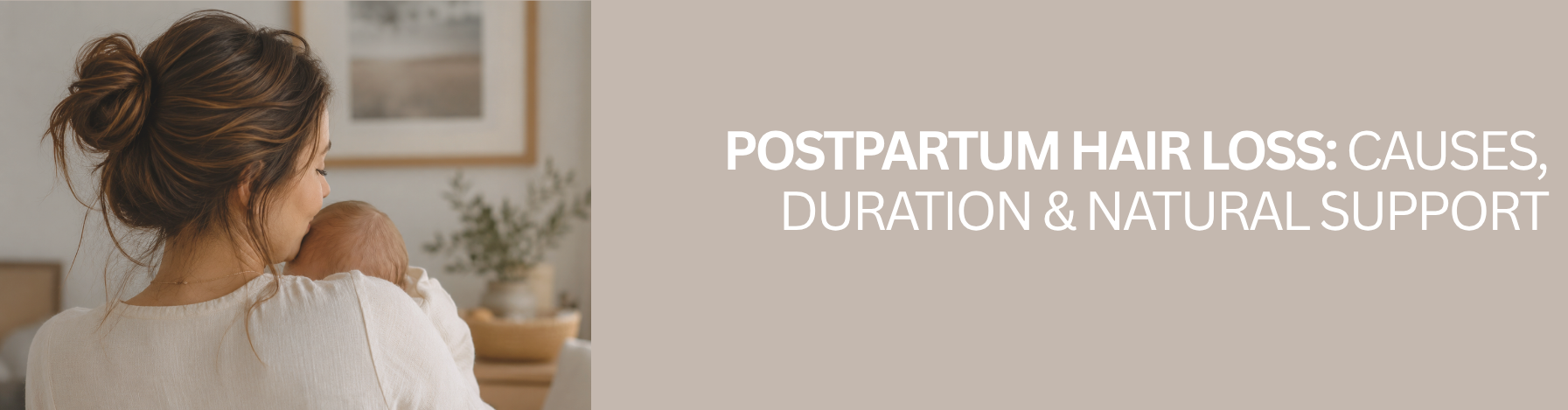
MOTHER HAIR LOSS POSTPARTUM CHILD

Postpartum hair loss: why it happens, how long it lasts, and how to support your hair

You're finding hair everywhere — on your pillow, in the shower drain, on the shoulder of your pyjamas. Your baby is just a few months old, you're in the middle of one of the biggest transformations of your life, and your body seems to be doing things entirely on its own terms.

If you're wondering whether this is normal: yes, it is. And no, you're not losing your hair forever.

What's really happening

During pregnancy, oestrogen levels rise significantly. One of the side effects — a pleasant one, for once — is that your hair stays in its growth phase and barely falls out at all. Your hair becomes thicker, shinier, more present.

After birth, oestrogen drops rapidly. Your body returns to its natural balance, and all the hair that had been "on hold" for nine months begins to shed at once. It's not an illness, not a deficiency, not a sign that something is wrong. It's your body resetting.

This phenomenon is called postpartum telogen effluvium, and it is one of the most well-documented conditions in dermatology and trichology.

The numbers, for those who want to understand

Under normal circumstances, we lose between 70 and 100 hairs a day — spread throughout the day in a way that goes almost unnoticed. After birth, this number can temporarily rise to between 200 and 300 hairs a day, with peaks during the most intense weeks. The shedding is distributed evenly across the scalp, without bald patches or thinning zones.

Hair loss typically begins 2–3 months after birth — not immediately — because this corresponds to the time follicles need to complete their resting phase before releasing the hair. Most new mothers see the shedding resolve within 6–12 months of giving birth.

If you are breastfeeding, the process may last a little longer, until weaning: prolactin maintains a certain hormonal balance that slows the return to normal, but it is not the primary cause.

When to see a doctor. If hair loss continues beyond 12 months, or is accompanied by unusual fatigue, weight changes, insomnia or mood swings, it is worth seeing an endocrinologist. In some cases, postpartum thyroiditis may be present — easily diagnosed with a simple blood test.

What makes it worse (and what helps)

The hormonal shift is the main cause, but it's not the only variable. Some things can make the phase longer or the shedding more intense:

Fatigue and stress from the postpartum period directly affect the hair cycle. This is not just an impression: elevated cortisol prolongs the follicular resting phase. Finding even twenty minutes a day for yourself is not a luxury.

Nutrition plays a role in supporting regrowth. Iron, zinc, biotin and B vitamins are the nutrients most involved in hair health. This is not the moment to eat poorly or skip meals.

Harsh products aggravate a scalp that is already under stress. Strong surfactants, synthetic fragrances, chemical dyes — anything that irritates or weakens the hair shaft during this phase should be avoided or postponed.

How you can support your hair right now

If you are breastfeeding, the first question you ask yourself about any product is: "can I use this?" It's the right question. Topical cosmetics such as shampoos and masks do not pass into breast milk, but it makes sense to choose formulas with a clean INCI, free from synthetic fragrances or aggressive ingredients — not only for your baby, but because your scalp is more reactive than usual during this phase. Glam1965 products are AIAB certified organic and vegan: you know exactly what's inside.

You can support regrowth with a gentle, effective routine — without compromising on ingredient transparency.

A shampoo that respects your scalp

It's the simplest daily gesture, and the most underestimated. At this stage, your scalp is sensitive: it needs to be cleansed without being stripped, stimulated without being irritated.

A1 Activating hair growth organic shampoo is formulated with organic rosemary extract, one of the most studied actives for stimulating scalp microcirculation, with a clean INCI and no aggressive ingredients. AIAB certified organic and vegan.

If your hair has become drier and more fragile — common in the postpartum period, when the structure and texture of the hair shaft can change — you may prefer H1 -Moisturizing hair growth organic shampoo, paired with H2- Moisturinzing Hair growth conditioner for complete care with every wash.

An intensive treatment for when you need it most

There are weeks when your hair seems to struggle on every front: dry, brittle, lifeless. A weekly treatment can make a real difference — not just to your hair, but to how you feel.

The Extra Moisturising Mask for Dry and Weakened Hair from the Specific line was designed for exactly this: restoring nourishment and softness to hair that has lost elasticity. Apply after shampooing, leave on for 10–15 minutes, rinse. It's a short ritual you can do while your baby sleeps.

Ampoules: targeted support

If you want to go beyond your wash routine and give your scalp more direct support, H3 Hydrating Anti-Hair Loss Ampoules are applied directly to the scalp, without rinsing. A cycle of 12 ampoules accompanies the most acute phase of shedding, supporting the follicle from the outside.

Support from within

Topical products work from the outside. From the inside, your body needs nutrients to build new, healthy hair.

Integra Hair & Nails is a food supplement based on keratin and millet extract, two of the most recommended nutrients for supporting hair structure.

Important note: if you are breastfeeding, please consult your doctor or midwife before starting any supplement. Not because there are known contraindications, but because it's always right to have professional guidance at this stage.

A final note

The postpartum period is a time when everything happens at once: you are caring for someone who depends entirely on you, while your own body is going through one of the most radical transformations of adult life. Hair loss is one of the visible signs of this process, and it can weigh more heavily than anyone expects.

Taking care of yourself is not vanity. It's a way of remembering that you are here too — with your needs, your hair, your body that is finding its way back.

Your hair will grow back. In the meantime, you deserve products that respect you and everything you are going through.

Discover how our Glam1965 line for hair and scalp can support you in all the phases of yout life.

Product added to wishlist

Product guide


Offers


Go to cart


Your account

Newsletter