


Your cart
There are no more items in your cart

- Blog
- 823 views
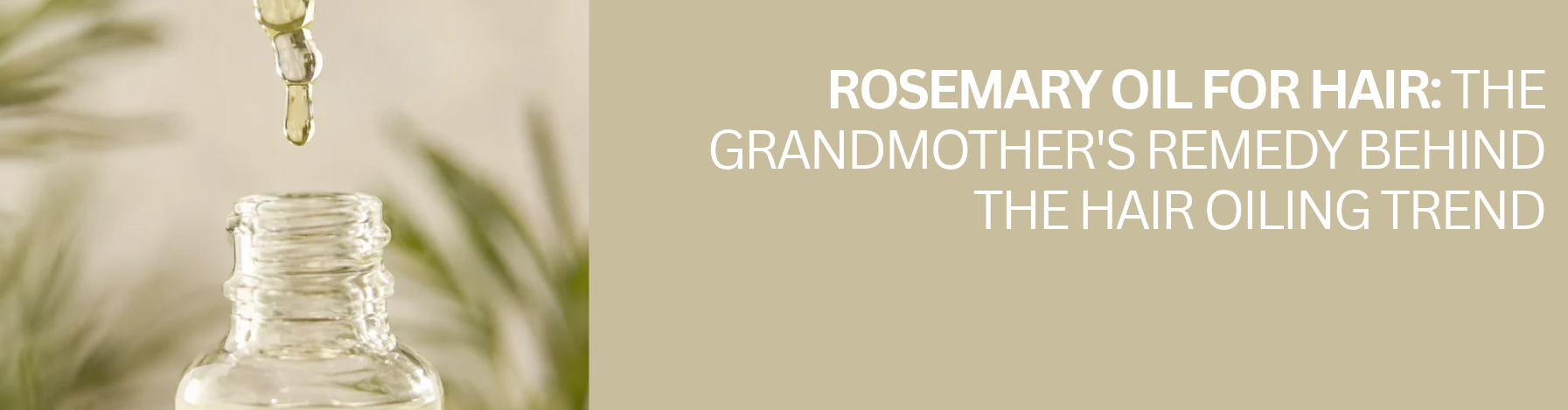
Rosemary Oil for Hair: The Grandmother's Remedy Behind the Hair Oiling Trend
There's a remedy that has been passed down for generations in Italian households, long before anyone talked about hair oiling or cosmetic actives: a sprig of rosemary steeped and used as a final hair rinse, or massaged directly onto the scalp. Grandmothers did it to "strengthen the hair." They didn't know exactly why it worked, but they knew that it did.
Today that same gesture has gone viral under a new name, hair oiling, and it's one of the most searched beauty trends right now: on Amazon alone, rosemary oil is the most searched hair oil of all. But behind the trend of the moment, what's actually going on?
What Essential Oils Are and Why They Matter for Hair
Essential oils are concentrated aromatic extracts, obtained mainly through steam distillation from flowers, leaves, bark, or roots. Unlike vegetable oils (such as jojoba or argan oil, rich in fatty acids and used to nourish and seal the hair fiber), essential oils are made up almost entirely of volatile, aromatic molecules, known as terpenes and phenols, which act in very small amounts but with a targeted effect.
In trichology, essential oils are chosen for three main types of action:
- Action on scalp microcirculation: some oils, applied with a light massage, help create a sensation of greater vitality in the scalp, supporting the feeling of a "reawakened" hair follicle.
- Sebum-regulating and purifying action: useful for scalps that tend to get oily quickly or that show flaking.
- Soothing and antioxidant action: many essential oils contain compounds that help counter oxidative stress at the follicle level, one of the factors that weakens hair over time.
Not all essential oils suit every scalp type, and above all, not all are safe when used undiluted. That's why, in the lab, the trickiest part isn't choosing the active ingredient: it's dosing and combining it into a stable, skin-safe formula.
Rosemary: The Plant That's More Than Just a Kitchen Herb
Rosemary (Rosmarinus officinalis) is one of the most studied aromatic plants for hair wellness. It grows wild throughout the Mediterranean, thriving in sun and poor soil, a natural resilience that may well be behind its long-standing reputation as the "strengthening plant."
Its essential oil is obtained through leaf distillation and is traditionally associated with:
- a feeling of a more toned, less fatigued scalp
- a perceived sense of fuller, thicker-looking hair
- a clean, herbaceous scent that many associate with the very idea of "healthy hair"
It's an ingredient that has recently become a social media star, but one that professional trichology has never stopped considering a solid ally.
How We've Worked With It, Over 60 Years in the Lab
For more than 60 years, our work at Delta BKB has been exactly this: taking what nature offers and turning it into a formula that truly works, not just one that sounds good on a label.
That's why rosemary essential oil is one of the oils we chose for our Glam1965 A1 Anti-Hair-Loss Shampoo, not on its own, but as part of a blend of essential oils designed to work in synergy:
- Salvia officinalis (Sage): long associated with scalp purification, it helps counter excess sebum and gives an immediate feeling of freshness.
- Eucalyptus: known for its soothing, refreshing action, useful for sensitive or redness-prone scalps.
- Thyme: one of the most studied essential oils for its purifying action, traditionally used to help keep the scalp balanced.
- Peppermint: delivers a pronounced cooling sensation and pleasantly stimulates the scalp during the washing massage.
Alongside these are botanical extracts such as radish root ferment, ginseng extract, and red clover and mung bean sprout extract, which complete the formula's functional profile.
We didn't add rosemary "because it's trending." We added it because, in our experience as formulators, it's one of the essential oils with the profile most consistent with the goal of an anti-hair-loss shampoo, and it's AIAB-certified, like the entire Glam1965 line.
The second step of the routine is the A2 organic oil, which works in a complementary way: it doesn't contain rosemary essential oil, but a concentrate of botanical actives such as ginger, elderflower, ginseng, and passionflower, designed to nourish and support hair between washes.
How to Use It in Your Autumn Routine
Autumn is when many people start noticing more noticeable shedding, the classic "seasonal hair fall." It's the right moment to introduce a targeted routine:
- Wash your hair 2–3 times a week with the A1 anti-hair-loss shampoo, letting it work for a few extra seconds during the massage to help the essential oils absorb
- Apply the A2 organic oil to the clean scalp, with a light circular massage
- Repeat consistently: just like with the grandmother's remedy, results here come from regularity, not occasional use
An Old Remedy, a Modern Formula
The beauty of grandmother's remedies is that they often hold a correct intuition, one that arrived well before the science existed to explain it. Our job, as a lab, is exactly that: taking that intuition and turning it into a safe, certified, effective formula.
Want to try a rosemary oil shampoo formulated for seasonal hair loss? Glam1965's A1 anti-hair-loss shampoo blends it with sage, eucalyptus, thyme, and peppermint, in an AIAB-certified formula. Discover it in our shop →